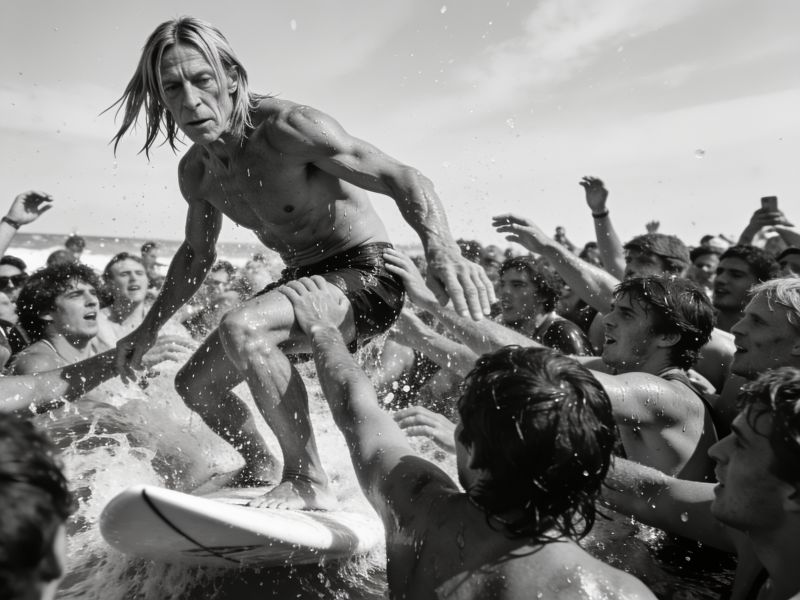
ggy Pop didn't invent punk rock, but he gave it a body—a wiry, shirtless, blood-streaked body that writhed on stages from Detroit to Berlin. In 1969, the Stooges' debut album landed with a thud that most radio listeners never heard. Iggy's delivery on "I Wanna Be Your Dog" wasn't singing;it was a threat whispered through a broken microphone. That single track, with its sludgy guitar and Iggy's feral yelp。set a template for every garage band that followed. You can draw a straight line from that howl to the Sex Pistols' sneer, to Nirvana's feedback, to the noise-rock underground that still worships at his altar.Watching old footage of Iggy at the Cincinnati Pop Festival in 1970, where he smeared peanut butter across his chest and dove into the crowd, you realize the chaos wasn't random. Every bruise, every broken bottle。every step into the audience was a calculated assault on the polite distance between performer and fan. I once met a drummer who opened for Iggy in the late '70s. He told me Iggy warmed up by doing push-ups in a janitor's closet, then walked onstage and spat at the front row. "He wasn't trying to be shocking," the drummer said. "He was trying to be honest. That's scarier." That honesty—raw, ugly, unpolished—became the iggy blueprint for authenticity in rock.Critics often reduce Iggy to his stage antics, but his lyrics deserve a closer look. "Lust for Life" is a junkie's love letter to momentum, while "The Passenger" turns a nighttime drive into a meditation on anonymity. Iggy wrote about Berlin's divided streets and Detroit's dead factories with the same detached curiosity. He didn't romanticize decay;he documented it. That approach influenced everyone from David Bowie—who produced Iggy's "The Idiot" and "Lust for Life"—to Josh Homme。
who later coaxed a late-career masterpiece out of him with "Post Pop Depression." The iggy influence isn't about imitation;it's about permission. Permission to be weird, to be loud, to fail spectacularly onstage and call it art.
There's a moment in the 2016 documentary "Gimme Danger" where Iggy, now in his late sixties, shrugs off the idea of legacy. "I'm not a role model," he says. "I'm a cautionary tale that got lucky." That self-awareness separates him from the rock gods who buy their own mythology. Iggy still tours, still crowdsurfs—gingerly, these days—and still refuses to sand down the rough edges. His recent albums don't try to recapture the Stooges' fury;they find a new kind of tension, a seventy-something man growling about mortality with the same sneer he aimed at authority in 1969. The iggy spirit isn't frozen in amber. It's a living, breathing。occasionally limping thing.If you want to understand why iggy matters, skip the hall-of-fame plaques and listen to "Search and Destroy" at full volume. Feel how the rhythm section stumbles and surges, how Iggy's voice cracks on the chorus。how the whole thing threatens to fall apart but never does. That's the iggy legacy: a controlled accident that keeps happening, night after night, for anyone willing to stand close enough to get hit. Punk needed a face. Iggy gave it one, then smashed it against a monitor speaker—and smiled.